 Photo Release Forms
How Cations Are Formed - See examples of the two types of ions, learn how they are different, and see periodic table trends. Ion, any atom or group of atoms that bears one or more positive or negative electrical charges. The term cation is derived from cathode ion, reflecting their attraction to the. Ions are charged atoms or molecules. Get the definitions of cations and anions. Cations what is a cation?

Ppt Ionic Bonding Powerpoint Presentation, Free Download Id2664362
The meaning of cation is the ion in an electrolyzed solution that migrates to the cathode. Anions are ions that are negatively charged. Cations are smaller than the corresponding parent atom or molecule due to the smaller size of the electron cloud. Ion, any atom or group of atoms that bears one or more positive or negative electrical charges. Some elements lose one or more electrons in forming ions.

How Are Cations Formed Electron Loss Explained With Examples
The meaning of cation is the ion in an electrolyzed solution that migrates to the cathode. Because one or more electrons are removed to form a cation, the cation of an atom is. Ion, any atom or group of atoms that bears one or more positive or negative electrical charges. These ions are known as cations because they are positively charged and migrate toward the negative electrode (cathode) in an.

How Are Cations Formed Electron Loss Explained With Examples
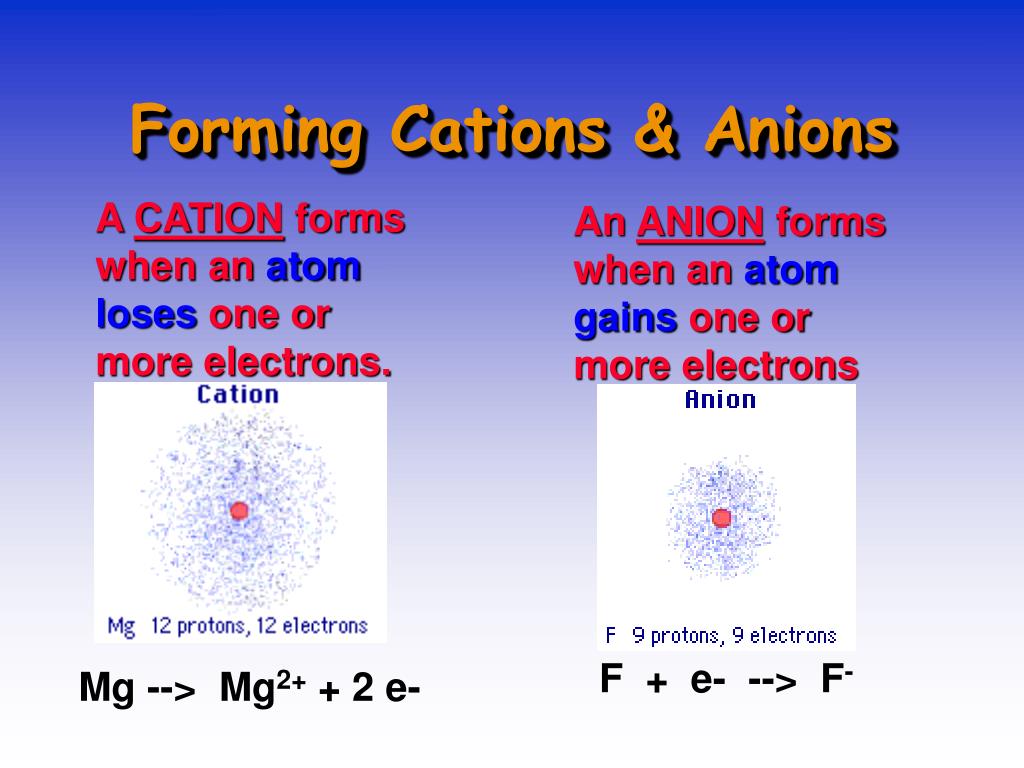
Ion, any atom or group of atoms that bears one or more positive or negative electrical charges. Cations are ions that are positively charged. Some elements lose one or more electrons in forming ions. Because one or more electrons are removed to form a cation, the cation of an atom is. See examples of the two types of ions, learn how they are different, and see periodic table trends.
Ppt Ions Powerpoint Presentation, Free Download Id5977908
See examples of the two types of ions, learn how they are different, and see periodic table trends. Cations are smaller than the corresponding parent atom or molecule due to the smaller size of the electron cloud. The meaning of cation is the ion in an electrolyzed solution that migrates to the cathode. Ions are charged atoms or molecules. Positively charged ions are called cations;.

How Are Cations Formed Electron Loss Explained With Examples
Cations are ions that are positively charged. Cations are positively charged ions that result from an atom or group of atoms losing one or more valence electrons. Anions are ions that are negatively charged. Cations are smaller than the corresponding parent atom or molecule due to the smaller size of the electron cloud. These ions are known as cations because they are positively charged and migrate toward the negative electrode (cathode) in an.
Because One Or More Electrons Are Removed To Form
Cations are smaller than the corresponding parent atom or molecule due to the smaller size of the electron cloud. A cation is an ion that has lost one or more electrons, giving a net positive charge. The meaning of cation is the ion in an electrolyzed solution that migrates to the cathode. Ions are charged atoms or molecules.
Anions Are Ions That Are Negatively Charged
Get the definitions of cations and anions. These ions are known as cations because they are positively charged and migrate toward the negative electrode (cathode) in an. One particular cation (that of hydrogen) contains no electrons, and thus consists of a. The term cation is derived from cathode ion, reflecting their attraction to the.
Cations Are Ions That Are Positively Charged
See examples of the two types of ions, learn how they are different, and see periodic table trends. Some elements lose one or more electrons in forming ions. Cations are positively charged ions that result from an atom or group of atoms losing one or more valence electrons. Positively charged ions are called cations.
Cations What Is A Cation?
Ion, any atom or group of atoms that bears one or more positive or negative electrical charges.