 Photo Release Forms
How Does A Warm Front Form - Stationary fronts can keep wet weather in one area for days, while occluded fronts form. As a result of its increased altitude, it cools off and its moisture condenses, forming clouds and possibly precipitation. A red line with semicircles pointing. It happens because air masses of different densities and. Weather fronts aren’t just random occurrences. However, while a warm front shows movement, a stationary front shows little.

Fronts, Clouds, Precipitation, And Forecasting
As a result of its increased altitude, it cools off and its moisture condenses, forming clouds and possibly precipitation. A cold front brings heavier precipitation, gusty winds, and sometimes thunderstorms. Weather fronts aren’t just random occurrences. Stationary fronts can keep wet weather in one area for days, while occluded fronts form. A warm front brings low ceilings, poor visibility, and light to moderate rain.

Chapter 12 Fronts And Airmasses Atmospheric Processes And Phenomena
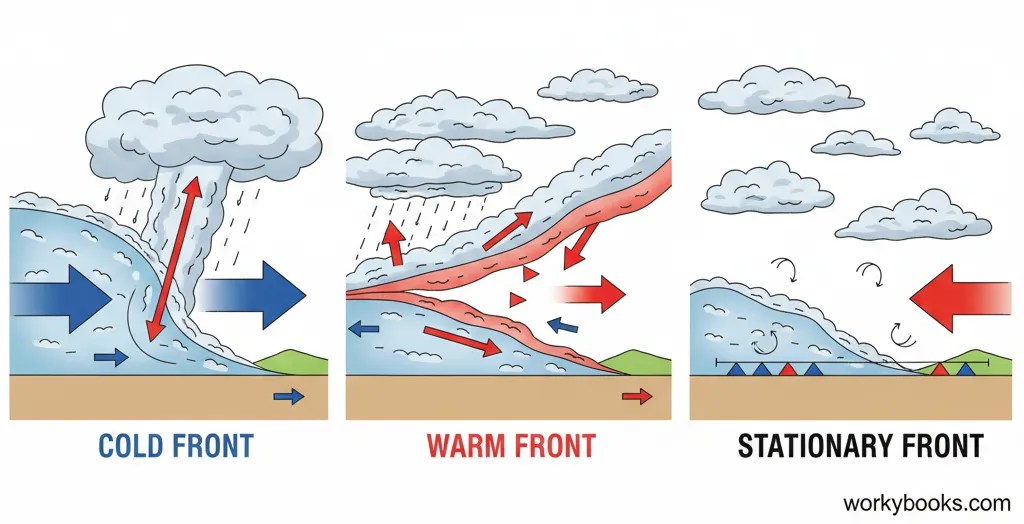
A warm front forms when a warm air mass pushes into a cooler air mass, shown in the image to the right (a). Weather fronts aren’t just random occurrences. However, while a warm front shows movement, a stationary front shows little. It happens because air masses of different densities and. The lighter warm air cannot displace the dense cold air forcefully, so it slowly rides up and.

Weather Fronts Explained (Cold, Warm, Stationary, Occluded) Pilot
Symbol commonly used to represent a warm front: A warm front forms when a warm air mass pushes into a cooler air mass, shown in the image to the right (a). See how a warm front forms and what weather it produces. Learn what a warm front is. The advancing air mass is relatively.
Weather Patterns Definition
The lighter warm air cannot displace the dense cold air forcefully, so it slowly rides up and. A warm front occurs when a warm air mass advances and gradually overtakes a retreating colder air mass. A stationary front is similar to a warm front, i.e., warm air is present behind it (to its south) with cool air ahead of it (to its north).

Weather Explained What Are Weather Fronts Weather News
A warm front lifts air more gently over cooler air, often producing widespread layered clouds and steady precipitation. A red line with semicircles pointing. See how a warm front forms and what weather it produces. Learn what a warm front is. Stationary fronts can keep wet weather in one area for days, while occluded fronts form.
A Warm Front Lifts Air More Gently Over Cooler
Study a diagram of a warm front and compare its features to a cold front’s. Symbol commonly used to represent a warm front: The formation of a warm front requires the interaction of two distinct air masses, each possessing different temperature and moisture characteristics. Stationary fronts can keep wet weather in one area for days, while occluded fronts form.
They Form When Two Air Masses With Distinct Characteristics—Such
However, while a warm front shows movement, a stationary front shows little. Weather fronts aren’t just random occurrences. Warm fronts often bring stormy weather as the warm air mass at the surface rises above the. Weather fronts form when warm and cold air masses collide.
The Lighter Warm Air Cannot Displace The Dense Cold
It happens because air masses of different densities and. A warm front brings low ceilings, poor visibility, and light to moderate rain. Learn what a warm front is. A cold front brings heavier precipitation, gusty winds, and sometimes thunderstorms.
A Warm Front Is The Boundary That Forms
A warm front occurs when a warm air mass advances and gradually overtakes a retreating colder air mass. See how a warm front forms and what weather it produces. A red line with semicircles pointing. A warm front forms when a warm air mass pushes into a cooler air mass, shown in the image to the right (a).