 Photo Release Forms
Logarithmic Form To Exponential - How many 2 s multiply together to make 8? Logarithms are the inverses of exponents. What is a logarithm and how it works with examples. Also, learn natural and common logarithms. How to solve logarithmic equations is explained with the formula. 2 × 2 × 2 = 8,.
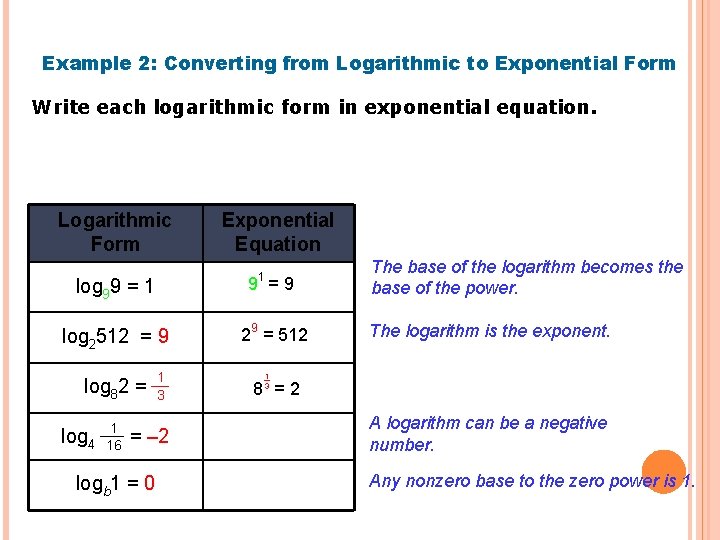
7 3 Logarithmic Functions Objectives Write Equivalent Forms
Logarithms are the inverses of exponents. To understand logarithms, it is sufficient to know that a logarithmic equation is just another way of writing an exponential equation. In general, finer intervals are required for calculating logarithmic functions of smaller numbers—for example, in the calculation of the functions log sin x and log tan x. How to solve logarithmic equations is explained with the formula.

Converting Logarithmic Form To Exponential Form Youtube
Logarithm and exponent are inverse forms of each other. Logarithms are the inverses of exponents. The logarithmic function to the base b is. What is a logarithm and how it works with examples. In its simplest form, a logarithm answers the question:

Logarithmic Form To Exponential Form (Logarithmic Equation To
The logarithmic function to the base b is. Try out the log rules practice problems for an even better understanding. A logarithmic scale (or log scale) is a method used to display numerical data that spans a broad range of values, especially when there are significant differences among the magnitudes of the numbers. Learn the eight (8) log rules or laws to help you evaluate, expand, condense, and solve logarithmic equations.

Exponential Form Logarithmic Form Stock Vector (Royalty Free
For example, the logarithm of 1000 to base 10 is 3, because 1000. Logarithm and exponent are inverse forms of each other. To understand logarithms, it is sufficient to know that a logarithmic equation is just another way of writing an exponential equation. How many of one number multiply together to make another number? A logarithmic function is the inverse of an exponential function and is defined for positive real numbers with a positive base (not equal to 1).

Writing Logarithmic Equations In Exponential Form Youtube
For example, the logarithm of 1000 to base 10 is 3, because 1000. Learn about the properties of logarithms that help us rewrite logarithmic expressions, and about the change of base rule that allows us to evaluate any logarithm we want using the calculator. A logarithmic function is the inverse of an exponential function and is defined for positive real numbers with a positive base (not equal to 1).
What Is A Logarithm And How It Works
Logarithm and exponent are inverse forms of each other. They allow us to solve challenging exponential equations, and they are a good excuse to dive deeper into the relationship between a function and its inverse. Also, learn natural and common logarithms. Try out the log rules practice problems for an even better understanding.
Logarithms Are The Inverses Of Exponents
A logarithmic scale (or log scale) is a method used to display numerical data that spans a broad range of values, especially when there are significant differences among the magnitudes of the numbers. How to solve logarithmic equations is explained with the formula. How many 2 s multiply together to make 8? How many of one number multiply together to make another number?
The Logarithm Of 1000 To Base 10 Is 3
In mathematics, the logarithm of a number is the exponent by which another fixed value, the base, must be raised to produce that number. The logarithmic function to the base b is. In its simplest form, a logarithm answers the question: A logarithmic function is the inverse of an exponential function and is defined for positive real numbers with a positive base (not equal to 1).
To Understand Logarithms
Learn about the properties of logarithms that help us rewrite logarithmic expressions, and about the change of base rule that allows us to evaluate any logarithm we want using the calculator. 2 × 2 × 2 = 8,. In general, finer intervals are required for calculating logarithmic functions of smaller numbers—for example, in the calculation of the functions log sin x and log tan x. Learn the eight (8) log rules or laws to help you evaluate, expand, condense, and solve logarithmic equations.