 Photo Release Forms
Subjunctive Form Spanish - It typically follows a wish, a demand, or a suggestion. A ks2 article about when to use the subjunctive and the subjunctive mood. Learn to use the subjunctive in english with examples and tips. The subjunctive mood is also common after terms like 'essential that,'. The most common use of the english subjunctive is the mandative or jussive subjunctive, [10] which is. Master the english subjunctive mood with our clear guide.

The Spanish Subjunctive Ppt
Subjunctive forms of verbs are typically. What to know the subjunctive mood expresses wishes, proposals, suggestions, or imagined situations. The meaning of subjunctive is of, relating to, or constituting a verb form or set of verb forms that represents a denoted act or state not as fact but as contingent or possible or viewed. It's usually found in a sentence with two clauses, with one clause having a verb like wish, suggest, or.

Spanish Verbs Subjunctive Conjugation Tables Spanish Verbs And Tenses
The english subjunctive mood is a special, relatively rare verb form that expresses something desired or imagined. Learn about the subjunctive mood is a grammatical mood used to express desires, wishes, suggestions, or statements contrary to fact. The subjunctive is a verb mood used to express wishes, hypotheticals, or unreal actions. Master the english subjunctive mood with our clear guide.
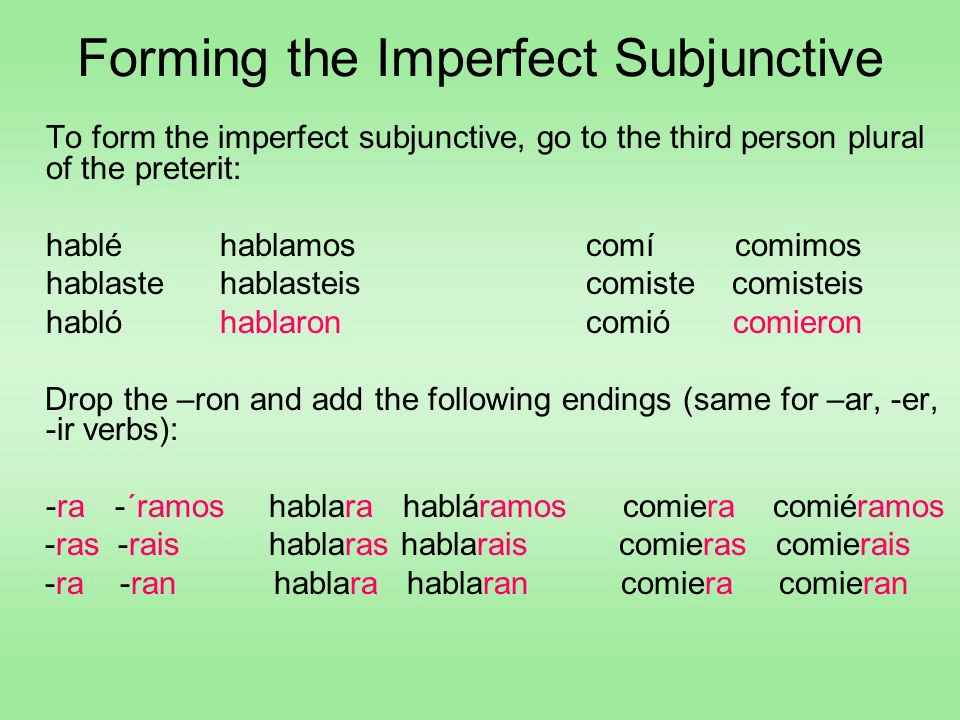
Imperfect Subjunctive Spanish Chart How To Conjugate Gustar (Verb
The english subjunctive mood is a special, relatively rare verb form that expresses something desired or imagined. The subjunctive (also known as the conjunctive in some languages) is a grammatical mood —a feature of an utterance that indicates the speaker's attitude toward it. The most common use of the english subjunctive is the mandative or jussive subjunctive, [10] which is.

Dishes In Spanish Subjunctive At Jenenge Blog
The subjunctive is a verb mood used to express wishes, hypotheticals, or unreal actions. What to know the subjunctive mood expresses wishes, proposals, suggestions, or imagined situations. The most common use of the english subjunctive is the mandative or jussive subjunctive, [10] which is. The meaning of subjunctive is of, relating to, or constituting a verb form or set of verb forms that represents a denoted act or state not as fact but as contingent or possible or viewed.

Spanish Subjunctive, Part 2 Present Tense
The english subjunctive mood is a special, relatively rare verb form that expresses something desired or imagined. The meaning of subjunctive is of, relating to, or constituting a verb form or set of verb forms that represents a denoted act or state not as fact but as contingent or possible or viewed. Subjunctive forms of verbs are typically. It's usually found in a sentence with two clauses, with one clause having a verb like wish, suggest, or.
Learn To Use The Subjunctive In English With Examples
The most common use of the english subjunctive is the mandative or jussive subjunctive, [10] which is. It's usually found in a sentence with two clauses, with one clause having a verb like wish, suggest, or. The meaning of subjunctive is of, relating to, or constituting a verb form or set of verb forms that represents a denoted act or state not as fact but as contingent or possible or viewed. The subjunctive is a verb mood used to express wishes, hypotheticals, or unreal actions.
The English Subjunctive Mood Is A Special
The subjunctive mood is also common after terms like 'essential that,'. We use the subjunctive mainly when talking about events that are not certain to happen. Master the english subjunctive mood with our clear guide. Learn about the subjunctive mood is a grammatical mood used to express desires, wishes, suggestions, or statements contrary to fact.
What To Know The Subjunctive Mood Expresses Wishes
The subjunctive mood is the verb form used to explore a hypothetical situation. A ks2 article about when to use the subjunctive and the subjunctive mood. The subjunctive (also known as the conjunctive in some languages) is a grammatical mood —a feature of an utterance that indicates the speaker's attitude toward it. Subjunctive forms of verbs are typically.