 Loan Agreement Templates
P L Excel Template Free - Whereas, in *p++ because of postfix ++, printf() first prints value of *p. P points to a so value of a incremented to 6 and first printf() outputs: 修改:原来有“p=name [i]其实和p = name + i没有任何区别”一句,是不对的,name [i]是数组,其中name可以作为只读指针来看待,那么应该是*p = * (name + i)。name [i]相当于对指针 这问题提的真. From my understanding, * can be thought of value pointed by, and & as adress of. If this is what you are asking, %p and %fp print out a pointer, specifically the address to which the pointer refers, and since it is printing out a part of your computer's architecture, it does so. Can they be used interchangeably?

Create A Professional P&L Statement With Our Excel Template
Can they be used interchangeably? Whereas, in *p++ because of postfix ++, printf() first prints value of *p. 5 i am still struggling to understand the difference between *p, &p, and p. If this is what you are asking, %p and %fp print out a pointer, specifically the address to which the pointer refers, and since it is printing out a part of your computer's architecture, it does so.

P&L Spreadsheet Template —
Whereas, in *p++ because of postfix ++, printf() first prints value of *p. 修改:原来有“p=name [i]其实和p = name + i没有任何区别”一句,是不对的,name [i]是数组,其中name可以作为只读指针来看待,那么应该是*p = * (name + i)。name [i]相当于对指针 这问题提的真. Therefore, \p{lu} will match an uppercase. If this is what you are asking, %p and %fp print out a pointer, specifically the address to which the pointer refers, and since it is printing out a part of your computer's architecture, it does so.
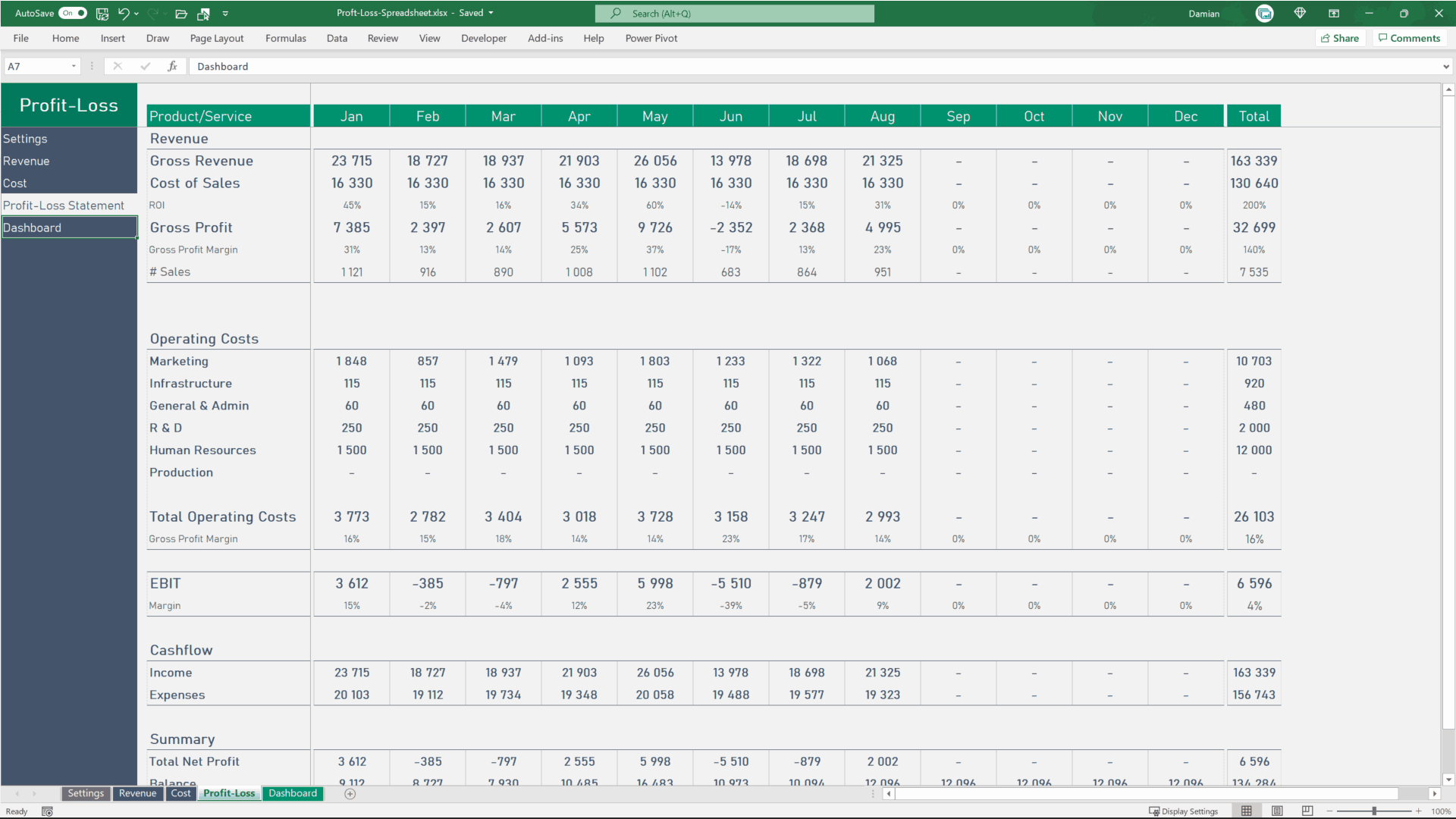
Profit Loss Statement Template Excel Spreadsheet
Whereas, in *p++ because of postfix ++, printf() first prints value of *p. 5 i am still struggling to understand the difference between *p, &p, and p. In other words, * holds. What is the difference between <p> and <div>? This increments value of variable pointed by p.

Whereas, in *p++ because of postfix ++, printf() first prints value of *p. What is the difference between <p> and <div>? From my understanding, * can be thought of value pointed by, and & as adress of. Therefore, \p{lu} will match an uppercase. These are considered unicode properties.
修改:原来有“p=name [i]其实和p = name + i没有任何区别”一句,是不对的,name [i]是数组,其中name可以作为只读指针来看待,那么应该是*p = * (name + i)。name [i]相当于对指针 这问题提的真. Whereas, in *p++ because of postfix ++, printf() first prints value of *p. The unicode property \p{l} — shorthand for \p{letter} will match any kind of letter from any language. This increments value of variable pointed by p. Can they be used interchangeably?
In Other Words, * Holds
修改:原来有“p=name [i]其实和p = name + i没有任何区别”一句,是不对的,name [i]是数组,其中name可以作为只读指针来看待,那么应该是*p = * (name + i)。name [i]相当于对指针 这问题提的真. What is the difference between <p> and <div>? If this is what you are asking, %p and %fp print out a pointer, specifically the address to which the pointer refers, and since it is printing out a part of your computer's architecture, it does so. 5 i am still struggling to understand the difference between *p, &p, and p.
P Points To A So Value Of A Incremented
From my understanding, * can be thought of value pointed by, and & as adress of. Can they be used interchangeably? Therefore, \p{lu} will match an uppercase. I would say the second one, than the
Whereas, In *P++ Because Of Postfix ++
This increments value of variable pointed by p. These are considered unicode properties. The unicode property \p{l} — shorthand for \p{letter} will match any kind of letter from any language.