 Biology Genetics Worksheets
Atomic Radius Periodic Trends Worksheet Answers - Suggest a reason for the trend observed. Up to 24% cash back 3. Given the tabulated value of 0.99 å for the atomic radius of cl, predict the atomic radius of bi. Explain why this trend occurs. Use your notes to answer the following questions. Support your answer, using examples from two periods.

Periodic Table Trends Atomic Radius Worksheet
Estimate the size of the smallest atom in the chart above. Identify which element is which from the data given. Up to 24% cash back in general, what is the trend in atomic radius as you go across a period (left to right) in model 1? Rank the following elements by increasing atomic radius: Given the tabulated value of 0.99 å for the atomic radius of cl, predict the atomic radius of bi.

Periodic Trends Atomic Radius Worksheet Answers Printable Calendars
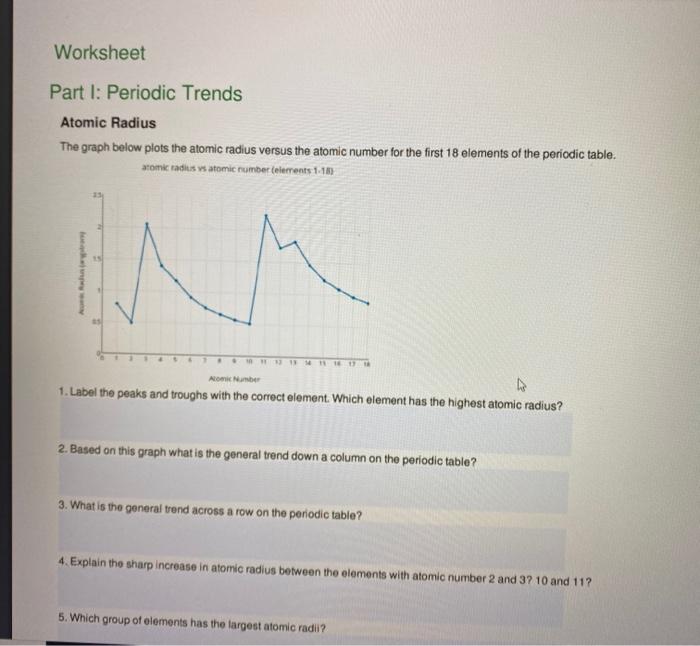
What trend in atomic radius, if any, is evident in the plot? The atomic radius gets smaller as atomic number increases. Calcium, iron, neon, nitrogen, silicon 2) rank the following elements by increasing electronegativity: Support your answer, using examples from two periods. Would you expect the same trend to be observed for the period 2 elements?.
Solved Worksheet Part I Periodic Trends Atomic Radius The
Rank the following elements by increasing atomic radius: Use your notes to answer the following questions. Table below gives the ionization energies for potassium, bromine and calcium. What trends do you notice for the atomic radii of period 3? For each of the following sets of atoms, rank the atoms from smallest to largest atomic radius.

Worksheet Periodic Trends With Answers Pdf
The atomic radius gets smaller as atomic number increases. Estimate the size of the smallest atom in the chart above. Atomic radius is the estimate of the size of an atom from the nucleus to its. What trend in atomic radius do you see as you go down a group/family on the periodic table? Know periodic trends of atomic size, ionic size, ionization energy, and electron affinity;.

Periodic Trends Worksheet
What trends do you notice for the atomic radii of group 2a? For each of the following sets of atoms, rank the atoms from smallest to largest atomic radius. Understand the reasons for metallic, nonmetallic, and metalloid character. Know periodic trends of atomic size, ionic size, ionization energy, and electron affinity. Explain why this trend occurs.
What Trends Do You Notice For The Atomic Radii
What trends do you notice for the atomic radii of period 3? What is the atomic radius? The atomic radius gets smaller as atomic number increases. Atomic radius is the estimate of the size of an atom from the nucleus to its.
What Trend In Atomic Radius Do You See
Estimate the size of the smallest atom in the chart above. Understand the reasons for metallic, nonmetallic, and metalloid character. What trend in atomic radius, if any, is evident in the plot? Up to 24% cash back extra practice:
Estimate The Size Of The Largest
Given the tabulated value of 0.99 å for the atomic radius of cl, predict the atomic radius of bi. For each of the following sets of atoms, rank the atoms from smallest to largest atomic radius. What trend in atomic radius. Calcium, iron, neon, nitrogen, silicon 2) rank the following elements by increasing electronegativity:
Support Your Answer, Using Examples From Two Periods
Which five elements are represented by the tallest ‘peaks’. Rank the following elements by increasing atomic radius: Identify which element is which from the data given. Explain your answer in the space provided.