 Biology Genetics Worksheets
Exponent Rules Review Worksheet - You can also calculate numbers to the power of large exponents less than 2000, negative exponents, and real numbers or. The meaning of exponent is a symbol written above and to the right of a mathematical expression to indicate the operation of raising to a power. For example, 2 to the 3rd (written like this: An exponent refers to the number of times a number is multiplied by itself. Exponent rules, laws of exponent and examples. An exponent tells us to multiply the base by itself that number of times.

Free Exponent Rules Review Worksheet Collection For Kids Worksheets
An exponent tells us to multiply the base by itself that number of times. 2 x 2 x 2 = 8. Interactive simulation the most controversial math riddle ever! You can also calculate numbers to the power of large exponents less than 2000, negative exponents, and real numbers or. For example, 2 to the 3rd (written like this:

Exponent Rules Review Worksheet Printable Pdf Template
2 3 is not the same as 2 x 3 = 6. For example, 35 = 3 · 3 · 3 · 3 · 3 = 243. 2 x 2 x 2 = 8. An exponent is a mathematical notation that represents how many times a number, called the base, is multiplied by itself. Exponents might look small, but they pack a serious punch.
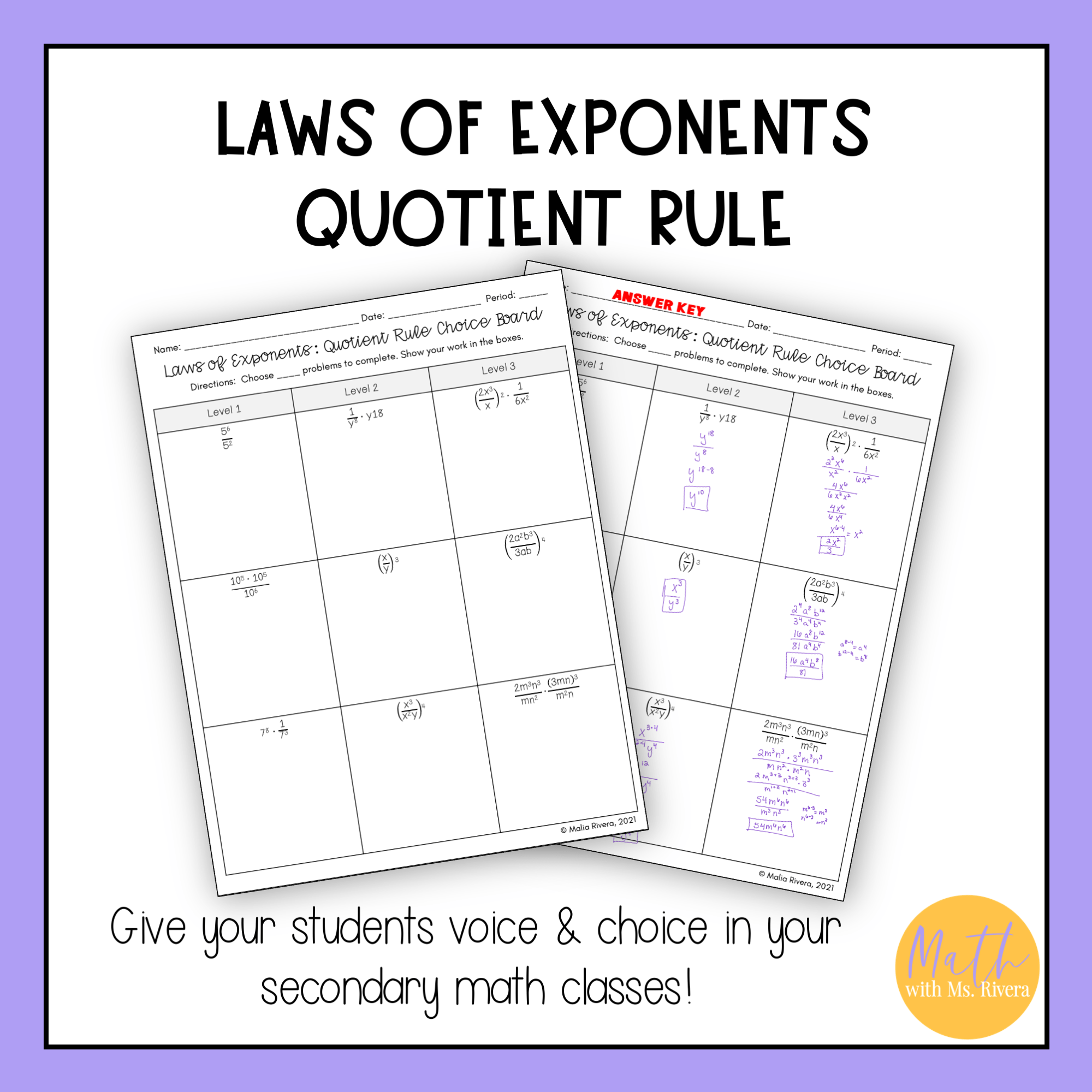
Rules For Exponents Worksheet
An exponent is a mathematical notation that represents how many times a number, called the base, is multiplied by itself. The exponent of a number says how many times to use the number in a multiplication. For example, 35 = 3 · 3 · 3 · 3 · 3 = 243. Calculate the power of large base integers and real numbers.

Exponent Rules Review Worksheet Answers
With just a little symbol, you can turn a long multiplication problem into a short and quick expression. Exponent rules, laws of exponent and examples. An exponent is a mathematical notation that represents how many times a number, called the base, is multiplied by itself. In our example, 4 3 tells us to multiply the base of 4 by itself 3 times: The base 3 appears 5 times in the.

Exponent Rules Notes And Worksheets Lindsay Bowden Worksheets Library
When an exponent is a positive integer, that exponent indicates how many copies of the base are multiplied together. With just a little symbol, you can turn a long multiplication problem into a short and quick expression. Exponent rules, laws of exponent and examples. For example, in 5 × 5 × 5, 5 is multiplied 3 times. In 82 the 2 says to use 8 twice in a multiplication, so 82 =.
In Our Example
When an exponent is a positive integer, that exponent indicates how many copies of the base are multiplied together. For example, 2 to the 3rd (written like this: 2 x 2 x 2 = 8. An exponent is a mathematical notation that represents how many times a number, called the base, is multiplied by itself.
An Exponent Refers To The Number Of Times
You can also calculate numbers to the power of large exponents less than 2000, negative exponents, and real numbers or. For example, 35 = 3 · 3 · 3 · 3 · 3 = 243. In 82 the 2 says to use 8 twice in a multiplication, so 82 =. 2 3 is not the same as 2 x 3 = 6.
How To Use Exponent In A Sentence
Interactive simulation the most controversial math riddle ever! An exponent tells us to multiply the base by itself that number of times. The meaning of exponent is a symbol written above and to the right of a mathematical expression to indicate the operation of raising to a power. The base 3 appears 5 times in the.
Calculate The Power Of Large Base Integers And Real
Exponent rules, laws of exponent and examples. Exponents might look small, but they pack a serious punch. The exponent of a number says how many times to use the number in a multiplication. For example, in 5 × 5 × 5, 5 is multiplied 3 times.