 Biology Genetics Worksheets
Integers Worksheet Multiplying And Dividing - The specific rules while performing the 4 operations. (but numbers like ½, 1.1 and −5 are not whole numbers.) counting numbers are whole numbers, but without the zero. Whole numbers are simply the numbers 0, 1, 2, 3, 4, 5,. This means integers do not include fractions or decimals. So, an integer is a whole number (not a fractional number) that can be positive, negative,. 1) addition, 2) subtraction, 3) multiplication, and 4) division.

Multiplying And Dividing Integers Advanced Lesson Worksheets Library
'integer' is a latin word which means 'whole' or 'intact'. Let us learn more about integers. Learn about the integers in math. Integers are a special set of numbers comprising zero, positive numbers, and negative numbers. Integers include all whole numbers and negative numbers.

Multiplying And Dividing Integers Worksheet Kuta Prntbl
'integer' is a latin word which means 'whole' or 'intact'. Integers are a special set of numbers comprising zero, positive numbers, and negative numbers. (but numbers like ½, 1.1 and −5 are not whole numbers.) counting numbers are whole numbers, but without the zero. Like other numbers, there are 4 basic operations associated with integers: Learn about the integers in math.

Multiplying And Dividing Integers Worksheet Proworksheet
Integers include all whole numbers and negative numbers. Whole numbers are simply the numbers 0, 1, 2, 3, 4, 5,. So, an integer is a whole number (not a fractional number) that can be positive, negative,. Learn about the integers in math. This means integers do not include fractions or decimals.
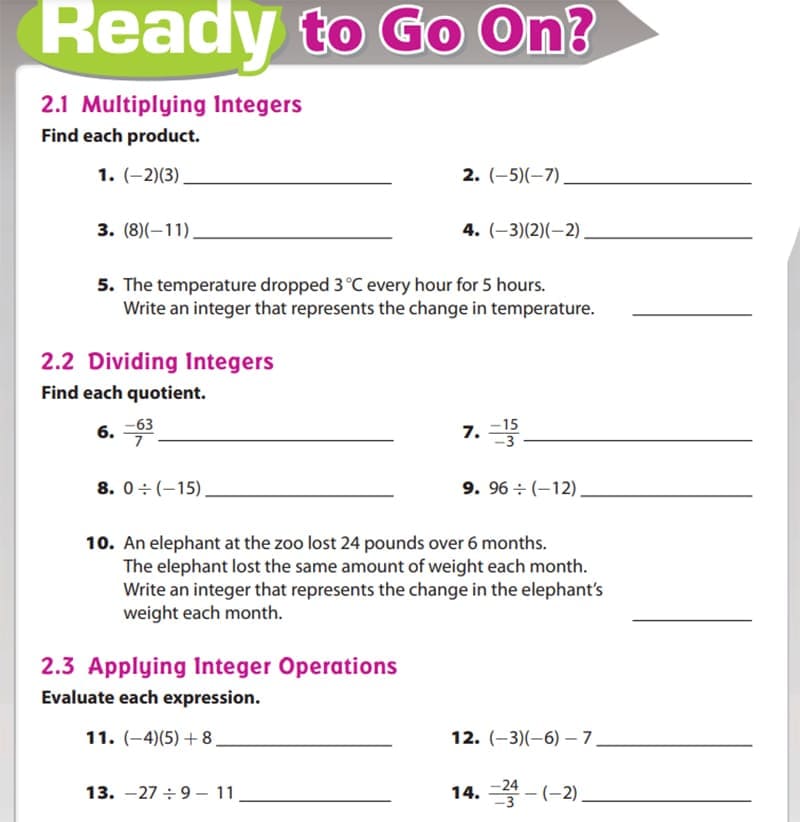
Multiplying And Dividing Integers Worksheets
Learn about the integers in math. Integers are a special set of numbers comprising zero, positive numbers, and negative numbers. Integers are a set of numbers that include all whole numbers (zero and positive numbers) as well as negative numbers. (and so on) no fractions! The specific rules while performing the 4 operations.

Multiplying And Dividing Integers Worksheet Kuta Prntbl
Integers do not include fractions or decimals. (but numbers like ½, 1.1 and −5 are not whole numbers.) counting numbers are whole numbers, but without the zero. Let us learn more about integers. Whole numbers are simply the numbers 0, 1, 2, 3, 4, 5,. Integers are a set of numbers that include all whole numbers (zero and positive numbers) as well as negative numbers.
This Means Integers Do Not Include Fractions Or Decimals
Whole numbers are simply the numbers 0, 1, 2, 3, 4, 5,. Integers do not include fractions or decimals. 'integer' is a latin word which means 'whole' or 'intact'. Integers are represented as algebraic terms built using a few basic operations (e.g., zero, succ, pred) and using natural numbers, which are assumed to be already constructed (using the peano approach).
An Integer Is A Whole Number (Not A Fractional
The specific rules while performing the 4 operations. Learn about the integers in math. Let us learn more about integers. Get their definition, see examples, and learn their properties and rules.
Integers Are A Set Of Numbers
Integers include all whole numbers and negative numbers. Integers are a special set of numbers comprising zero, positive numbers, and negative numbers. Like other numbers, there are 4 basic operations associated with integers: (and so on) no fractions!
1) Addition, 2) Subtraction, 3) Multiplication, And 4) Division
(but numbers like ½, 1.1 and −5 are not whole numbers.) counting numbers are whole numbers, but without the zero.