 Biology Genetics Worksheets
Limiting Reagent Percent Yield Worksheet Answers - 2) if 23 grams of iron (ii). 4 s 2 cl 2 (l) what is the maximum amount of s. 5 co 2 (g) + i 2 (g) a) 80 grams of iodine(v) oxide, i 2 o 5 , reacts with 28 grams of. 1) write the balanced equation for the reaction that occurs when iron (ii) chloride is mixed with sodium phosphate forming iron (ii) phosphate and sodium chloride. In an experiment, 3.25 g of nh 3 are allowed to react with 3.50 g of o 2. Solve stoichiometric problems from a balanced chemical equation.

Quiz & Worksheet Calculating Reaction Yield And Percentage Yield
What is the limiting reagent in the reaction described in problem 2? The limiting reagent gives the smallest yield of product calculated from the reagents (reactants). Cucl + nano à cu(no), + nacl a) if 0.11. Identify the limiting reactant when 1.22g of o₂. Solve stoichiometric problems from a balanced chemical equation.

Limiting Reagent And Percent Yield Answers
For the balanced equation shown below, if the reaction of 40.8 grams of c6h6o3 produces a 39.0% yield, how many grams of. The equation for the reaction given: Answers includes practice material with verbal quantitative and analytical past papers questions class 8 12 chemistry quiz questions and answers pdf download a book to review textbook. Solve stoichiometric problems from a balanced chemical equation.

Solved Worksheet On Limiting Reactants Use The Following
Limiting reagents and percent yield answer all questions on separate paper and report all answers to the correct number of sig figs. Actual yields in drug synthesis and purification. Write the balanced equation for the reaction given above: Sch 3u limiting reagent worksheet answers. Identify the limiting reactant when 1.22g of o₂.

Limiting Reagent Worksheet 1 Answers Percent Yield Worksheet
Sch 3u limiting reagent worksheet answers. Cucl + nano à cu(no), + nacl a) if 0.11. Detailed solutions to limiting reagent problems 1. Potassium superoxide, ko2, is used in rebreathing masks to generate oxygen according to the reaction below. 2) if 23 grams of iron (ii).
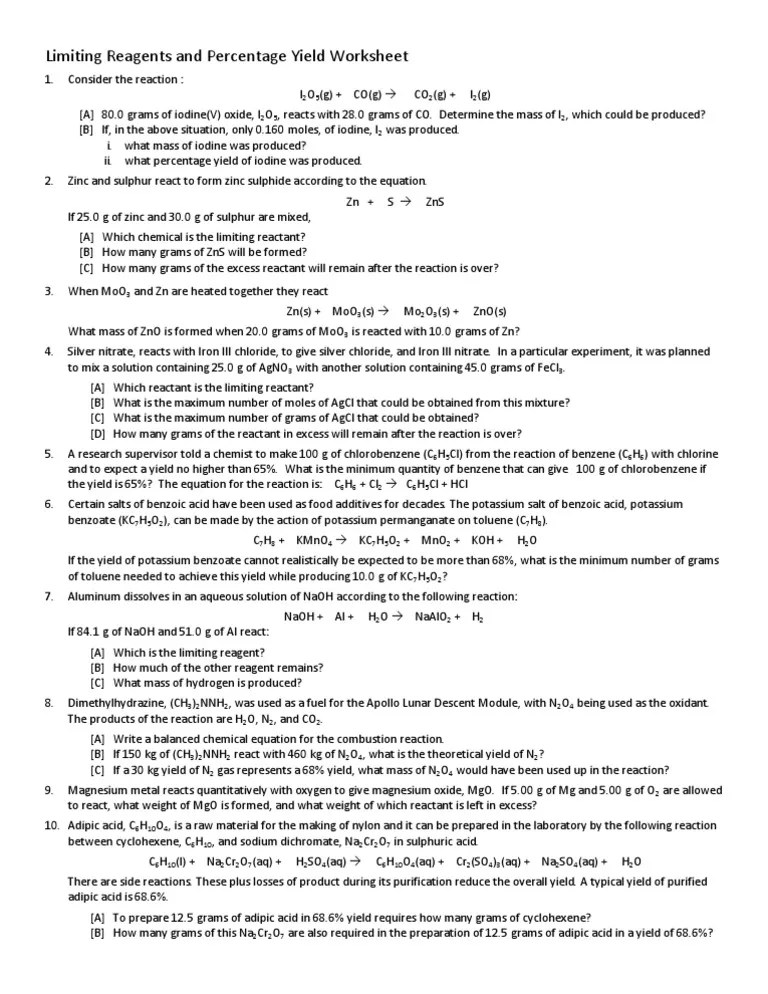
Limiting Reagents And Percentage Yield Worksheet Zinc Chemical
Since it is said that 137.1 g of water were collected after the reaction, that is the actual yield. S 82 (s) + 4 cl (g) ! Limiting reagents (answer key) take the reaction: Because sodium iodide is the reagent that causes 8.51 grams of sodium nitrate to be formed, it is the limiting reagent. What is the mass of each product that can be formed?
If The Mask Contains 0.150 Mol Ko2 And
For the following reactions, find the following: What is the limiting reagent in the reaction described in problem 2? It includes calculations for several chemical reactions to. The document provides examples of stoichiometry calculations involving limiting reagents, theoretical and percentage yields.
4 S 2 Cl 2 (L) What
Write the balanced equation for the reaction given above: Cucl + nano à cu(no), + nacl a) if 0.11. The limiting reagent gives the smallest yield of product calculated from the reagents (reactants). Theoretical yield = 20.1 g.
Because Sodium Iodide Is The Reagent That Causes 8.51
Sch 3u limiting reagent worksheet answers. 2) if 23 grams of iron (ii). Potassium superoxide, ko2, is used in rebreathing masks to generate oxygen according to the reaction below. Solve stoichiometric problems from a balanced chemical equation.
S 82 (S) + 4 Cl (G)
Worksheet #14 limiting reagents 1. When copper (ii) chloride reacts with sodium nitrate, copper (ii) nitrate and sodium chloride are formed. 3) what is the limiting reagent in the reaction described in problem 2? 1) write the balanced equation for the reaction that occurs when iron (ii) chloride is mixed with sodium phosphate forming iron (ii) phosphate and sodium chloride.