 Biology Genetics Worksheets
Percent Calculations Worksheet - 100 percent (100%) of a number is the same number: See how to use percent formulas to calculate percentages and find. How do you find a percent of a number? 1 percent represents 1/100 fraction. The percent sign % (sometimes per cent sign in british english) is the symbol used to indicate a percentage, a number or ratio as a fraction of 100. Unlock private credit investments with percent.

Percentage Worksheets Math Monks
To find a percent of a number, you can write the percent as a fraction and then multiply the fraction by the total amount. The percent sign % (sometimes per cent sign in british english) is the symbol used to indicate a percentage, a number or ratio as a fraction of 100. Unlock private credit investments with percent. The meaning of percent is one part in a hundred.

Percent Worksheets Percent Worksheets For Practice
Access alternative investments on the platform powering the future of private markets. 100 percent (100%) of a number is the same number: When we say percent we are really saying per 100. The percent sign % (sometimes per cent sign in british english) is the symbol used to indicate a percentage, a number or ratio as a fraction of 100.

Calculate Percentage By Breaking Down Numbers Worksheet Download
Percentage is a value that represents the proportion of one number to another number. To find a percent of a number, you can write the percent as a fraction and then multiply the fraction by the total amount. It is one of the ways to represent a dimensionless relationship between two numbers. How do you find a percent of a number?
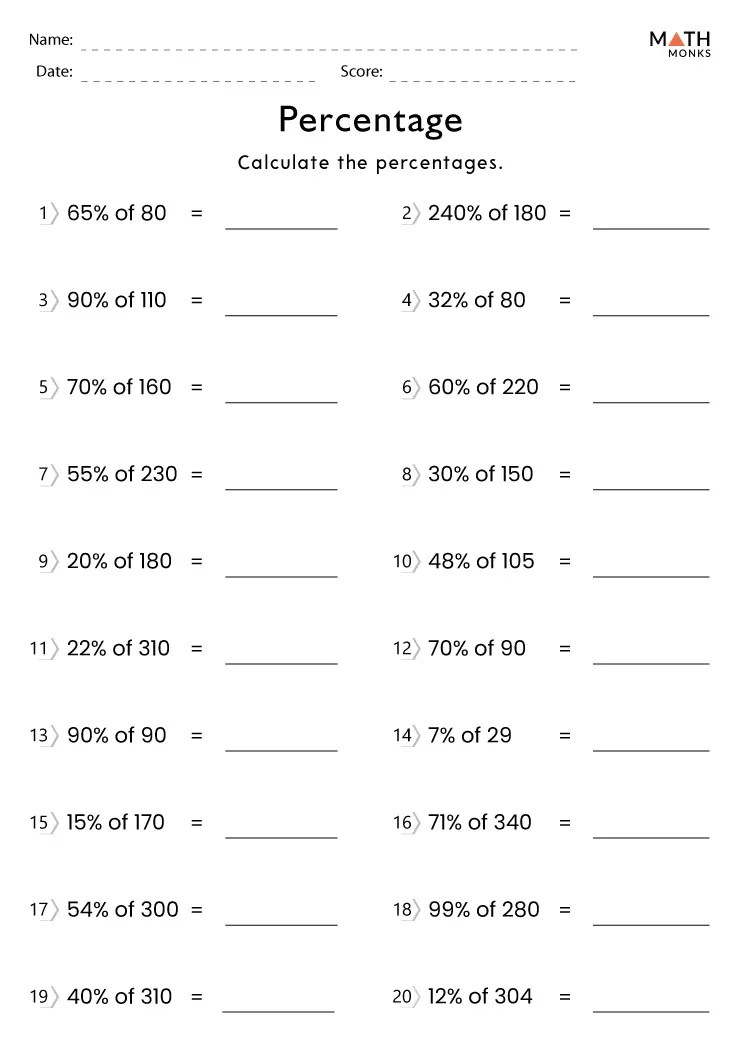
Grade 5 Percentage Worksheets Math Monks
Unlock private credit investments with percent. 1% of this line is shaded green: It is often denoted using the percent sign (%), [1] although the. How to use percent in a sentence. The percent sign % (sometimes per cent sign in british english) is the symbol used to indicate a percentage, a number or ratio as a fraction of 100.

Percents Finding The Original Worksheet Pdf Printable Number
One percent (1%) means 1 per 100. 1 percent represents 1/100 fraction. Related signs include the permille (per thousand). To find a percent of a number, you can write the percent as a fraction and then multiply the fraction by the total amount. To calculate a percentage, you typically divide the part (the smaller value) by the whole (the larger value), and then multiply the result by 100.
The Percent Sign % (Sometimes Per Cent Sign
One percent (1%) means 1 per 100. 100 percent (100%) of a number is the same number: 1% of this line is shaded green: How do you find a percent of a number?
Use This Calculator To Find Percentage Of A Whole
1 percent represents 1/100 fraction. It is often denoted using the percent sign (%), [1] although the. Related signs include the permille (per thousand). In mathematics, a percentage is a number or ratio that represents a fraction of 100.
This Gives You The Percentage Value As A Number
To find a percent of a number, you can write the percent as a fraction and then multiply the fraction by the total amount. See how to use percent formulas to calculate percentages and find. Unlock private credit investments with percent. How to use percent in a sentence.
Percentage Is A Value
It is one of the ways to represent a dimensionless relationship between two numbers. To calculate a percentage, you typically divide the part (the smaller value) by the whole (the larger value), and then multiply the result by 100. The meaning of percent is one part in a hundred. In mathematics, a percentage, percent, or per cent (from latin per centum 'by a hundred') is a number or ratio expressed as a fraction of 100.