 Biology Genetics Worksheets
Periodic Trends Atomic Radius Worksheet Answers - Support your answer, using examples from two periods. Therefore, the element on the far left (k) is the largest, and the element on the far right (br) is the smallest. What trend in atomic radius do you see as you go down a group/family on the periodic table? Explain in words and with a diagram why ionic radius of cations and anions is different from their atoms. What trends do you notice for the atomic radii of period 3? Answer the following questions about atomic radius in complete sentences.

Name ___Date Worksheet Periodic Trends 1. Atomic Radius
What is the periodic trend for atomic. It also answers questions about trends in atomic radius, ionization energy and. What is the periodic trend for atomic. What trend in atomic radius do you see as you go down a group/family on the periodic table? What trend in atomic radius do you see as you go down a group/family on the periodic table?
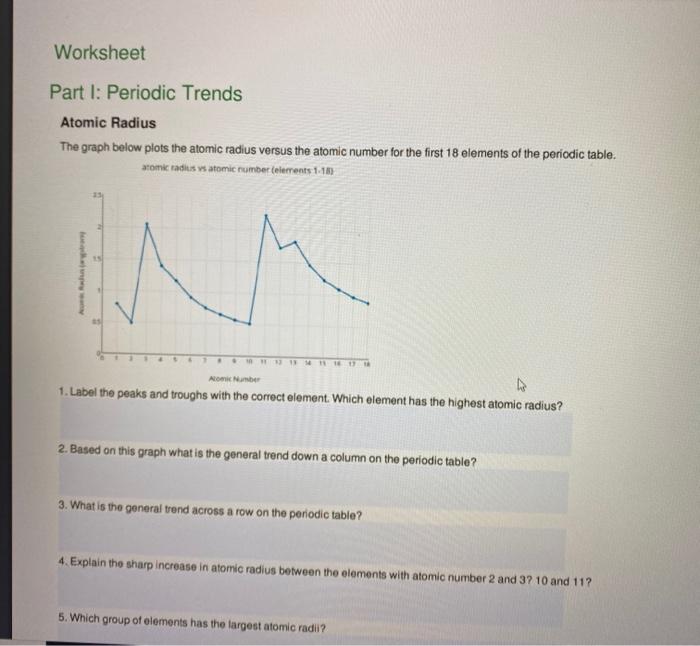
Solved Worksheet Part I Periodic Trends Atomic Radius The
Estimate the size of the smallest atom in the chart above. It also answers questions about trends in atomic radius, ionization energy and. 1) rank the following elements by increasing atomic radius: Which atom in each pair has the larger atomic radius? Therefore, the element on the far left (k) is the largest, and the element on the far right (br) is the smallest.

Periodic Table Trends Atomic Radius Worksheet
Explain why this trend occurs. What is the periodic trend for atomic. For each of the following sets of atoms, rank the atoms from smallest to largest atomic radius. Which atom in each pair has the larger atomic radius? It also answers questions about trends in atomic radius, ionization energy and.

Periodic Trends Atomic Radius Worksheet Answers
Atomic radius for each of the following sets of atoms, rank the atoms from smallest to largest atomic radius. Describe specific reasons for this variation across a period and within a group. What trends do you notice for the atomic radii of group 2a? The atomic radius gets smaller as atomic number increases. What trends do you notice for the atomic radii of period 3?

Periodic Table Trends Atomic Radius
For each of the following sets of atoms, rank the atoms from smallest to largest atomic radius. The trend in atomic radius as you go across a period is decreasing. Rank the following elements by increasing atomic radius: Atomic radius for each of the following sets of atoms, rank the atoms from smallest to largest atomic radius. Understand the reasons for metallic, nonmetallic, and metalloid character;.
Use The Periodic Table And Your Knowledge Of Periodic
Describe specific reasons for this variation across a period and within a group. Which five elements are represented by the tallest ‘peaks’. Which atom in each pair has the larger atomic radius? Support your answer, using examples from two periods.
What Trend In Atomic Radius Do You See
Periodic trends atomic radius the graph below plots the atomic radius versus the atomic number for the first 18 elements of the periodic table. It also answers questions about trends in atomic radius, ionization energy and. What trend in atomic radius do you see as you go down a group/family on the periodic table? Answer the following questions about atomic radius in complete sentences.
Rank The Following Elements By Increasing Atomic Radius
Atomic radius decreases as you go left to right across a period. Beryllium is in the farthest to the left, and neon is the farthest to the right of the four elements. Going from left to right across a. What is the periodic trend for atomic.
It Provides The Answers To Questions About Classifying Elements
Estimate the size of the smallest atom in the chart above. Which atom in each pair has the larger atomic radius? Understand the reasons for metallic, nonmetallic, and metalloid character. Explain why this trend occurs.