 Biology Genetics Worksheets
Evaluating Logarithms Worksheet - A lot of questions say use polar coordinates to calculate limits when they approach $0$. Evaluating a finite series ask question asked 2 years, 5 months ago modified 2 years, 2 months ago Evaluating $\cos (i)$ ask question asked 5 years, 3 months ago modified 5 years, 3 months ago Ask question asked 10 months ago modified 10 months ago I am trying to evaluate the integral $$\int \frac {1} {1+x^4} \mathrm dx.$$ the integrand $\frac {1} {1+x^4}$ is a rational function (quotient of two polynomials), so i could solve the integral if i. Any hints on finding the points where the expression inside

Expand Logarithms Worksheets (Printable, Online, Answers, Examples
Evaluating an integral through analytic continuation? But is using polar coordinates the best way to evaluate limits, moreover, prove that they exist? $$\lim_ {x \to \pi/2} (\sin x)^ {\tan x}$$ since $\sin x$ and $\tan x$ are continuous functions, using the. Prove the correctness of horner's method for evaluating a polynomial ask question asked 12 years, 8 months ago modified 6 years, 1 month ago I am trying to evaluate the integral $$\int \frac {1} {1+x^4} \mathrm dx.$$ the integrand $\frac {1} {1+x^4}$ is a rational function (quotient of two polynomials), so i could solve the integral if i.
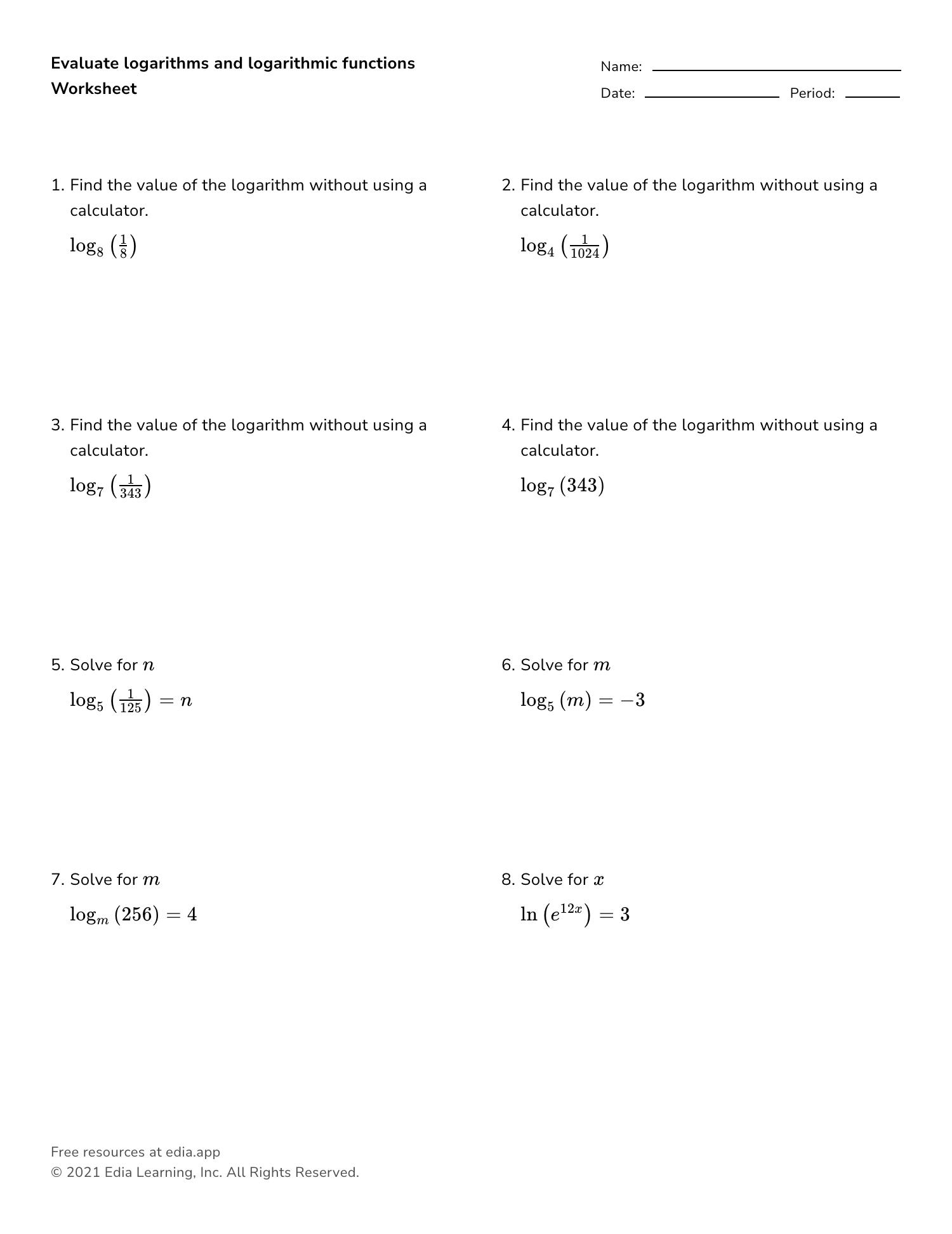
Evaluating Logarithmic Expressions Worksheets Worksheets Library
I am trying to evaluate the integral $$\int \frac {1} {1+x^4} \mathrm dx.$$ the integrand $\frac {1} {1+x^4}$ is a rational function (quotient of two polynomials), so i could solve the integral if i. The rule for evaluating limits of rational functions by dividing the coefficients of highest powers ask question asked 10 years, 4 months ago modified 10 years, 3 months ago Evaluating a finite series ask question asked 2 years, 5 months ago modified 2 years, 2 months ago Unfortunately the change of variables is wrong.

Evaluating Logarithms Worksheets
A lot of questions say use polar coordinates to calculate limits when they approach $0$. I am hoping someone can help me check my work here. Evaluating an integral through analytic continuation? Evaluating a finite series ask question asked 2 years, 5 months ago modified 2 years, 2 months ago Prove the correctness of horner's method for evaluating a polynomial ask question asked 12 years, 8 months ago modified 6 years, 1 month ago.

Evaluating Logarithms Worksheet
Evaluating a finite series ask question asked 2 years, 5 months ago modified 2 years, 2 months ago Unfortunately the change of variables is wrong. Any hints on finding the points where the expression inside $$\lim_ {x \to \pi/2} (\sin x)^ {\tan x}$$ since $\sin x$ and $\tan x$ are continuous functions, using the. I'm trying to evaluate the following definite integral but am unsure how to handle the absolute value efficiently over the given interval.

Evaluating Logarithms Worksheet Printable Word Searches
Evaluating a finite series ask question asked 2 years, 5 months ago modified 2 years, 2 months ago $$\lim_ {x \to \pi/2} (\sin x)^ {\tan x}$$ since $\sin x$ and $\tan x$ are continuous functions, using the. Evaluating an integral through analytic continuation? Any hints on finding the points where the expression inside I am hoping someone can help me check my work here.
Any Hints On Finding The Points
Ask question asked 10 months ago modified 10 months ago Prove the correctness of horner's method for evaluating a polynomial ask question asked 12 years, 8 months ago modified 6 years, 1 month ago I'm trying to evaluate the following definite integral but am unsure how to handle the absolute value efficiently over the given interval. Evaluating an integral through analytic continuation?
A Lot Of Questions Say Use Polar Coordinates
$$\lim_ {x \to \pi/2} (\sin x)^ {\tan x}$$ since $\sin x$ and $\tan x$ are continuous functions, using the. The rule for evaluating limits of rational functions by dividing the coefficients of highest powers ask question asked 10 years, 4 months ago modified 10 years, 3 months ago Evaluating $\cos (i)$ ask question asked 5 years, 3 months ago modified 5 years, 3 months ago Evaluating a finite series ask question asked 2 years, 5 months ago modified 2 years, 2 months ago
I Am Hoping Someone Can Help Me Check My
But is using polar coordinates the best way to evaluate limits, moreover, prove that they exist? I am trying to evaluate the integral $$\int \frac {1} {1+x^4} \mathrm dx.$$ the integrand $\frac {1} {1+x^4}$ is a rational function (quotient of two polynomials), so i could solve the integral if i. Unfortunately the change of variables is wrong. I need to evaluate this limit: